The MA … and then it was over

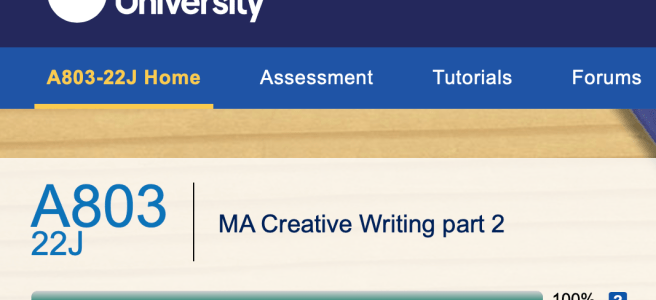
It has taken me a couple of weeks to decompress from it … but after 2 years the MA I was studying in Creative writing at the Open University is over.

The last assignment is submitted, the last few forum messages/threads have been read and responded to, the tutor group WhatsApp group is active (Yay!). The mark for my final submission is now in the hands of the Gods – or at least the tutors that will get to read it.

I’ve not really blogged about the course as I’ve been going through it, in fact I’ve not blogged about much – a good deal of my creative writing energy has gone into the course itself. Those who have undertaken such an endeavour will know that the time is consumed with exercises to do, workshop submissions to critique, forum messages to post, respond to, and pass comment on (relating to any and all of the above). Plus, the assignments of course; the more significant undertakings that you get marked on.

But having reached the end, I did think I’d creatively write about it … just for me (which coincidently is pretty much the entire readership of my blog).

The first year

This passed by relatively uneventfully. For a portion of it, covid lockdowns kept everyone home working, life was in some ways simpler without having to slot in commuting.

My other hobby/passion is running, and that is equally as time consuming. Scarce a day went by when I didn’t engage with the course material/objectives in some way, and likewise running too is an (almost) daily activity.

But the first year was, on reflection, a time to experiment, to learn and attempt new things. The marks for it don’t carry through to the second year, so in many ways scoring just highly enough to continue to the second year was outcome enough (although me being me, it did matter).

My first piece, a short story crime whodunnit (spoiler alert, they all did it) ran into my recurring barrier, too many words and too big an idea for a fixed word count. This resulted in a tale that was reminiscent of the end of an Agatha Christie novel or the iconic “An Inspector Calls” where the policeman outlines the events of the case.

This fell foul of having too much happen “off camera” which is a fair assessment. The action did indeed all happen in the days before the narration commenced. The idea though, is filed away. One day the four intertwining stories that I had to summarise and cajole into 2500 words might make a fuller (and less “told”) story. As was fed back to me, “exposition isn’t plot”, so next time expect to see everything that happens.

The second, a foray into creative non-fiction, was written in the challenging 2nd person. It was running themed and autobiographical. Recounting the way my own marathon running developed over the course of several races. Using the style of Lorrie Moore’ How to become a Writer, I relived the training, highs and lows and ultimate success of my sub-4-hour marathon journey. It was a story filled with passion and emotion (for me) and tears were shed when editing it.

Then the third and final “continuously assessed” piece was another story: A tragic tale of workhouse life and a brother and sister wrongly accused of a crime.

This Victorian workhouse setting was deliberately chosen – my final piece (the “final exam” if you like) was to be set in a similar, but futuristic equivalent. It was narrated by the two protagonists and swapped point-of-view between them. And if there was one criticism that stayed with me, it was that it didn’t need to. Maybe the lesson there was to write for the reader rather than how you want the story to be told (a lesson that I must admit is a controversial one in my psyche).

Then the final piece, the so-called EMA, came to life. A longer story about a girl in a futuristic corporation-run orphanage/workhouse. A dystopian take on the direction of society. It was deliberate in its setting and theme as looking ahead, I had a plan to work on another piece of dystopia for the larger end of year 2 piece. Hence, The Unwanted was something of a practice run.

In an attempt to ape the style of the greats like Atwood and Orwell I told my tale but crashed into the “exposition” challenge slightly that I’ve realised is my writer’s Achilles heel.

The year, however, was a success, a good mark, a sense of accomplishment, and onto the next challenge – year 2.

The second year

The first thing to stress is that while year 1 was 9 months long – September to May – year 2 was a full 12 months. There were more assignments, and the final piece (akin to a dissertation) was a sizeable 15,000 words. Writing and editing a piece of that size was going to be (and was) a big ask.

In fact, the whole year was a big ask.

Home working had been replaced with three days in the office, in the October my Dad sadly died so I had his illness and then his funeral and then his estate to sort out. Then as gthe course drew to int conclusion I was to be moving house. It was, it’s fair to say, an emotional time – the sort of time when an uptick in workload takes some coping with.

The assignments started well, the highest mark so far was for the first one – a first-person story in diary-format of a small boy who is bullied at school, so under the cover of lockdown Zoom-based education he changes school by himself. His mother, the villain of this particular piece, then finds out near the end. She was a hateful woman – don’t have any sympathy for her. Unless you happen to read the short follow up piece I composed for an activity; that was very dark.

The second story a was thriller set in an airport departure lounge, in the city where a marathon was being run, and in a hotel. It was a nice idea but did suffer from being a touch implausible. While the plot didn’t have holes as such, there were some thinner bits on closer inspection.

Then came the non-fiction assignment, about Margaret Atwood and her influence on my writing. If I made one mistake here it was that I focussed on her ability to create ideas and write across so many genres at a general level, rather than her writing style in particular. But influence works in different ways and comes in different forms. I’d stand by my assessment of how she influenced my writing. The dystopian future she paints in The Handmaids Tale and Oryx and Crake held particular relevance, given the year one speculative fiction “practice run” EMA and the plans I had for year 2’s longer piece.

It did mark the start of the path to the year 2 EMA, as this assignment also included a proposal for the EMA…

… and that’s where things got complicated.

The concept: “1985” – a sequel to 1984 – was one of my favourite ideas and had been gestating in my brain for some time, before the course in fact. But for a university submission, using the same world and characters would be seen as lacking originality, and to then get published (once complete) would encounter probably insurmountable copyright issues. Thus, on two fronts, the concept fell down hard – but after some panic, and then more reasoned thought, the idea morphed. It turned out to be a different story set further in the future, with a similar idea for plot but new characters and a new backdrop. Forum was born.

People say the movie Starwars is a western, but no one will accuse it of ripping off The Good, the Bad and the Ugly. I followed a similar strategy.

So, dissertation proposal revamped and completely changed we reached the fourth assignment, and the last standalone one – another short story. Set in a fictional version of my Dementia-addled mum’s mind, narrated by someone in the same mental state, a tale of misunderstandings and confusion came to light. It held some emotional baggage for me.

The marking for this one I felt was harsh. I was there for most of the factual versions of the fictionalised events. Getting stuck in the porch wasn’t a more dramatic event to dwell on, the angst of committing a loved one to a care home was the hard part. But it’s OK, I wrote it the way I wanted to. It was a piece for me, not the reader. I think those with loved ones affected by dementia would get it.

The fifth assignment was ungraded – it was an appraisal of the start of the final dissertation. Unimportant from a mark point of view (in fact there was no mark), but the feedback and comments were vital and absolute gold dust to the success in the later assignment.

And then, in parallel with work having started on the dissertation, we had to write about our learnings and experiences on the course. How we’d grown, been educated, what influences and inspirations we had drawn leading up to that final EMA submission. As a journey, it had been a long and eventful one. I wrote about it, and once again, this came back OK.

The final act

The last 3-4 months were then dominated by writing 15,000 words of the start of the novel, Forum. I’d say writing it was probably the easy part. I got 15,000 words down in good time.

But editing – PHEW – my tutor group and I all read and re-read our own work, shared it with others who read it too and provided their comments, and the whole cycle went around and around ad infinitum (or almost).

I added, chopped, changed. At one point I added so much to the early sections that a whole chapter later on had to drop off the end. The stories we all wrote, gradually tightened up as they were polished. And then, in the last week of September in the middle of 3 crazy weeks at work and a week out from a marathon in Scotland, the deadline came and the submit button was pressed.

A silent prayer drifted up, and a huge feeling of gratitude for all the people that took the time to read and provide comments – I owe you all. The final draft was significantly better than the first. That much is certain.

It’s done.

OH GOD!

What’s next?

So yes, it’s over, in a way at least.

The marks don’t come back till December (when I will have to revisit this blog) so that’s a long wait and could make for a really nice Christmas. The work is over, but in another sense it has only just started.

Having written the start of Forum, I now have to write the rest. I handed in 15,000 words, I’ve got another 2,500 in the chapter I had to drop off the end, so I’m 100% finished on the course, but only 25% through the full novel.

I better get on with it. But I wanted to stop and write something else first.

You’re welcome.

Writing about Margaret Atwood & George Orwell

For my MA on Creative Writing we were asked to research the career paths of two favourite writers. How they first got published, their day jobs, how much they have been published and whether they have written about their process as writers etc.

I am planning on writing an essay on Margaret Atwood for an assignment and writing a sequel to Nineteen Eight-four for another, so I chose Atwood and Orwell for this exercise. Refreshing myself on Atwood’s background would be useful. And knowing Orwell’s background may also help. Plus, I’ve read a lot of books by them both.

At this point my strong belief in fate throws in a twist. I had decided to call the essay on Atwood “Who does Margaret Atwood think she is?” As a working title it felt like it might have legs. Subsequently, I rapidly start trying to get through Negotiating with the Dead, her book on writing for writers (as per the brief above) and what is the first chapter of that book called? It’s called “Orientation: Who do you think you are?“. Maybe the writing Gods are on my side for this.

Margaret Atwood

I’m a huge fan of Margaret Atwood, her versatility (even if you look at her novels alone) is astounding in my view. And then you add on the poetry, short stories, anthologies, teaching etc… There is much to admire.

A Canadian, she was born in 1939 in Ottawa. Her mother was a nutritionist and her father an entomologist. It is possible, I think, to see the echoes of this background in some of her writing. For example, the novel Cat’s Eye, follows a group of children growing up in Canada; while Oryx and Crake features the scientific realms of genetic manipulation and cloning.

She is perhaps best known for The Handmaid’s Tale, the dystopian or speculative fiction novel about a religious society, Gilead, that oppresses and persecutes women. It’s been the subject of television adaptations and is regularly drawn on to call out the more worrying trends in society today, even though it was written in 1985, almost 40 years ago. Atwood has famously said she’d written nothing in it that hasn’t actually happened. Sadly, I fear there are often several real-life examples to choose from.

But to return to her versatility, even among the books of hers that I have personally read, you have the scientific predictions of Oryx and Crake (and its sequels), the political and religious warnings of The Handmaid’s Tale and its sequel The Testaments (which is more of a espionage/resistance-type story). But then the heart-wrenching account of a difficult childhood, rural life and bullying in Cat’s Eye, the historical (and real-life) nature of Alias Grace – which is a fictional tale based on an actual murder; the intrigue of Blind Assassin, and the shorter Penelopiad – which tells the story of Penelope, wife of Odysseus, offering an interesting perspective on the classic Homerian tale. This isn’t an exhaustive list either.

All deeply impressive for someone who didn’t attend school properly until the age of 12 and decided to write professionally aged only 16.

In terms of sharing her experience, one particular example of for Margaret Atwood is the online MasterClass: https://www.masterclass.com/classes/margaret-atwood-teaches-creative-writing which I was lucky enough to be able to work through. Alongside her book Negotiating with the Dead, which I have just started reading (https://www.goodreads.com/book/show/17647.Negotiating_with_the_Dead)

George Orwell

George Orwell, real name Eric Arthur Blair, was born in 1903 in India.

Perhaps most famous for his significant, fateful and  important dystopian novel Nineteen Eight-Four alongside the stunningly caustic appraisal of communism in Animal Farm, he’s nothing if not an author with a conscience – and in that regard he has something in common with Atwood. This is perhaps brought into the sharpish relief by the non-fiction Down and Out in Paris and London a book about the extreme poverty suffered by the lowliest in society.

He was educated in England, worked in Burma as a policeman, fought in the Spanish civil war, then as a journalist for the BBC. With all that going on its no surprise that he wasn’t as industrious in the literary sphere as Atwood, but as with Handmaids Tale, the foresight of Nineteen Eighty-Four led to him having great influence in the modern-day. The term “Orwellian” has been coined to describe a despotic, oppressive regime and is sadly too often found to be useful. Terms like doublethink, room 101 and big brother are also in widespread popular cultural use too, sadly.

Considering Nineteen Eighty-Four was published in 1949 shortly before Orwell’s death in 1950, thus some 35 years ahead of its time, he has a chillingly enduring legacy.

For aspiring writers, Orwell has posited 6 pieces of advice:

  1. Never use a metaphor, simile, or other figure of speech which you are used to seeing in print.
  2. Never use a long word where a short one will do.
  3. If it is possible to cut a word out, always cut it out.
  4. Never use the passive where you can use the active.
  5. Never use a foreign phrase, a scientific word, or a jargon word if you can think of an everyday English equivalent.
  6. Break any of these rules sooner than say anything outright barbarous.

Sources

https://en.wikipedia.org/wiki/Margaret_Atwood

https://en.wikipedia.org/wiki/George_Orwell

https://www.keystonetutors.com/news/george-orwells-6-rules-for-writing-good-english

A Eulogy

I had to read this out loud back in December, but as I’ve waded through the paperwork of a life I thought I would post it somewhere for posterity.

When he was in hospital this last time, Dad was sleeping a lot – they’d said they didn’t expect him to make it. One evening I took a bible in to read to him. I didn’t know what else to do. I only knew Psalm 23, so I started with the next one Psalm 24, and it rang very true.
Who may ascend the mountain of the Lord?
Who may stand in his holy place?
The one who has clean hands and a pure heart,
who does not trust in an idol
or swear by a false god.
They will receive blessing from the Lord
and vindication from God their Saviour.

I thought that pretty much sums up Dad.


Roy Wilson was born on 21st April 1936 in Yiewsley and was part of the Methodist church there. The church was always an important big part of his life.
He attended boarding school but was also a keen tennis player and played at all levels, including at Wimbledon in the men’s and mixed doubles between 1950 and 1956. His eyes started to trouble him though, and he had to stop playing. So he took up table tennis instead.
On June 6th 1964, He married Eileen Sherlock at the church in Chipstead Valley Road in Coulsdon and as they wanted a home of their own, and knew they would never have afforded one in Surrey, they moved to Enderby, buying the house in Kipling Drive that they spent the rest of their lives in, brand new for £2,460.
They attended the Methodist church in Enderby. Back in 1964 it needed a lot of work done on it, both structurally and cosmetically. And Roy and Eileen got involved from the start.
Every Saturday there would be fund-raising coffee mornings, together with bric-a-brac stalls and a raffle. Roy and Eileen suggested that as there was a reasonable kitchen they could do hot meals in winter and cold in the summer together with a dessert and a cup of tea. This became very popular with the older people of the village as they would do their shopping in the Co-op and then meet up for lunch and a chat.
Roy was the church treasurer for many years and Eileen was a steward and they both worked incredibly hard for the church.
Roy worked for Trusthouse Forte as a hotel accountant, then went to work at a boutique luxury hotel called Stapleford Hall, and then – in what was probably his dream job – he became the accountant for Age Concern in Leicester. An organisation that does so much good work, including for Roy and Eileen in their own twilight years.
However, when the charity sector found itself strapped for cash, the charity had to let him go and he then went to work as the accountant for an engineering and manufacturing company in Hinckley until he retired.
His other passions were steam trains and stamp collecting, he decided to specialise in collecting the stamps of Lichtenstein – for reasons known best to himself – and he regularly went to the Leicester philatelic society – “Stamp Club” as he called it.
The years passed, Roy and Eileen’s 40th anniversary was in 2004 and the family a huge get together. They just passed their 58th anniversary in June this year.
Sadly, in the last few years Eileen has been affected badly by Alzheimers disease and after looking after her for a long time – longer than was good for him – the decision was made to move her to a care home in January 2021. A hard decision for Roy, he went to see her every week without fail until he was taken into hospital earlier this year. Eileen isn’t here today as she’s not well enough to be told of her husband’s death or to attend the funeral.
Roy cared for Eileen till the end, we went to see her for her birthday in September when he had briefly been discharged from hospital. He was quite specific as to what type of cake they should arrange for her for her birthday. He wanted it to be strawberry.


I saw Dad a lot in the last two years. Sorting out paperwork and finances. I called it “Dadmin”, but while trailing around the banks was a hassle, it did mean we spent more time together. It became a bit of a joint project. With hindsight it was a blessing – even if I moaned about traffic and the journey and the bureaucracy to anyone who would listen.
I was telling someone recently about my earliest memory.
Mum was in hospital just after having Zoe and Dad and I were going in to see her and my new baby sister. My memory is that Dad bought Mum a new mop as a present – one of those ones that you can squidge out with a handle on the side.
For a woman with a new baby that would have been the worst present ever. Looking back, I’m sure Dad had probably broken the old mop cleaning the floor, and we had just bought a new one from the hardware store on the way into Leicester in the car. When we got home that evening there was a power cut and we had toast and marmite done under the grill and a jug of hot chocolate made on the stove by candlelight for tea.
Dad was in hospital a lot this year, he never really recovered from the fall when he was weeding the garden, and the heart operation complications that affected his mobility. Everything seemed to knock him back a little bit more.
I was looking for things to say today to finish. And I found this poem.

God saw you getting tired
And a cure was not to be
So He put His arms around you
And whispered ‘Come with Me.’

Blog 4.0

It’s strange to be starting a new blog. It’s not the first, so perhaps I should get this one right and persevere with it, rather than adding a few posts, leaving it to lie fallow, and then forgetting about it.

The past ones have been a mixed bag:

  • Runningpiers.blogspot.com – the first blog I set up, mainly to write about running, but then drifted into topics as diverse as porridge and pop music
  • Medium – within which I uploaded my two “playing with my food” photo blogs, and a couple of other experiments
  • Vocal – which is just a story I wrote, that was going to be a whole series, but not really a blog

I do also write blogs for work, and most of those are published. No byline though.

But then in the second year of my Creative Writing MA (with the Open University) the course materials suggested creating a blog, and none of those past ones seemed to be the right starting point. So here I am – and here you are!

I’m not sure how much attention this is going to get paid in the short term… I currently have:

  • A full time job
  • A second voluntary role as a board member for a professional body
  • A funeral to arrange and an estate to wind up
  • Running to do (two marathons next year hopefully)
  • A scrappy first draft of a book to edit
  • An MA in Creative Writing to complete

So it might be sporadic at best.